
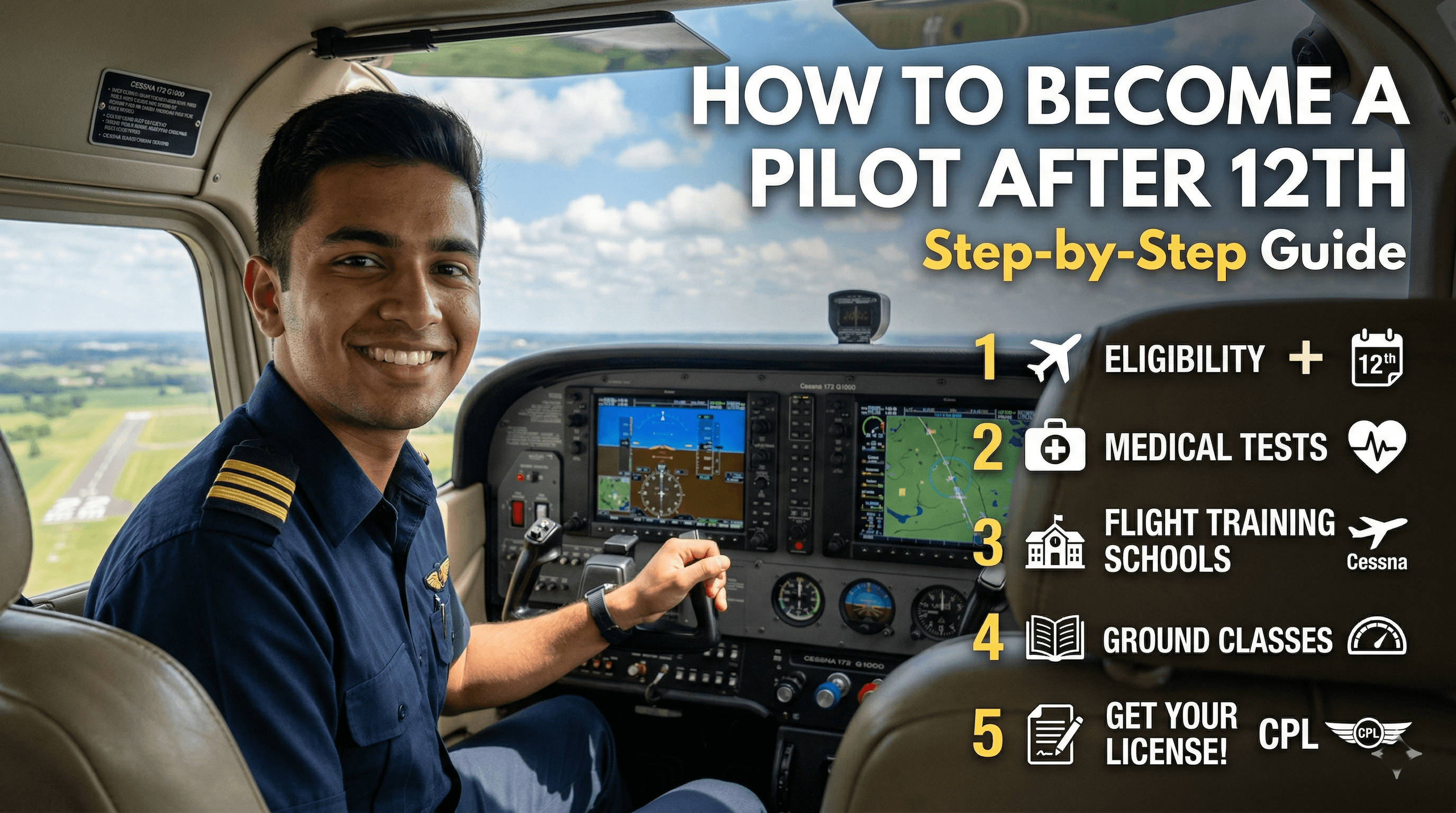
Have you ever looked up at a jet streaking across the blue sky and thought, "I want to be the one in that cockpit"? You’re not alone. The allure of the skies, the crisp uniform, and the sheer thrill of commanding a multi-ton machine through the clouds is a dream for many.
But let’s be real: the path to becoming a pilot often feels shrouded in mystery. Is it all about math? Do you need perfect vision? How much does it actually cost? If you’ve just finished your 12th grade (or are about to), you are at the perfect jumping-off point.
In this guide, we’re breaking down the flight path from a high school graduate to a commercial pilot, keeping it grounded in reality while aiming for the stars.
1. Check Your Flight Instruments: Eligibility Criteria
Before you can fly, you need to make sure you meet the basic requirements. Think of this as your pre-flight checklist.
Academic Requirements
To join a flying club or a cadet program, the standard requirement is:
- Subjects: You must have cleared 12th grade with Physics and Mathematics.
- Minimum Marks: Most academies look for an aggregate of 50%, though this can vary.
- What if I’m a Commerce/Arts student? Don’t panic. You can still become a pilot! You’ll need to clear the Physics and Mathematics exams separately through the National Institute of Open Schooling (NIOS) to meet the Directorate General of Civil Aviation (DGCA) requirements.
Age and Medical Fitness
- Age: You must be at least 17 years old to start flight training and 18 to hold a Commercial Pilot License (CPL).
- Medical Fitness: This is non-negotiable. You need to pass a Class II Medical Assessment initially, followed by a Class I Medical for your commercial license. These exams check your eyesight (6/6 vision is preferred, but corrected vision is often acceptable), hearing, heart health, and general physical fitness.
2. Choosing Your Route: CPL vs. Cadet Programs
There are two primary ways to earn your wings after the 12th. Choosing the right one depends on your budget and career goals.
Option A: The Conventional Way (Flying Schools)
This involves enrolling in a Flying Training Organization (FTO). You pay for your ground classes and flying hours as you go.
- Pros: Generally cheaper than cadet programs; you have the freedom to choose your school.
- Cons: You are responsible for your own job search after getting your license.
Option B: Cadet Pilot Programs
Many major airlines (like IndiGo, Air India, or Emirates) run their own "Cadet Programs."
- Pros: These programs offer a Letter of Intent (LOI), which essentially means you have a job waiting for you once you finish the course. The training is highly structured and tailored to that specific airline.
- Cons: Extremely expensive (often double the cost of conventional training) and highly competitive.
3. The Three Pillars of Pilot Training
To become a pilot, you don't just jump in a plane and pull a lever. Your training is split into three distinct phases.
Phase 1: Ground School
Before you touch the controls, you have to hit the books. You’ll study subjects like:
- Air Navigation: How to get from Point A to Point B without getting lost.
- Aviation Meteorology: Understanding weather patterns and how to avoid storms.
- Air Regulation: The "traffic laws" of the sky.
- Technical General & Specific: How the engines and aircraft systems actually work.
Phase 2: Flying Hours
This is where the magic happens. You’ll start with a flight instructor (Dual flying) and eventually move to your first "Solo" flight—a moment every pilot remembers forever. To get a CPL, you typically need to log 200 hours of flying time, including cross-country flights and night flying.
Phase 3: Type Rating
Getting your CPL means you can fly a small, single-engine plane. But to fly an Airbus A320 or a Boeing 737 for an airline, you need a Type Rating. This is specialized training for a specific aircraft model, usually conducted in high-tech simulators.
4. The Financial Reality: How Much Does it Cost?
Let’s have some "cockpit candor." Becoming a pilot is one of the most expensive career paths.
- Conventional Route: In India or abroad (USA, South Africa, New Zealand), the cost of a CPL typically ranges from $45,000 to $65,000 (roughly ₹40 to ₹60 Lakhs).
- Cadet Programs: These can go upwards of $100,000 to $120,000 (₹1 Crore+), including Type Rating.
Pro-Tip: Many banks offer specialized education loans for pilot training. Additionally, some state governments offer scholarships for aspiring pilots from diverse backgrounds.
5. Life as a Commercial Pilot: Expectation vs. Reality
The life of a pilot isn't just about the view from 35,000 feet. It’s a lifestyle choice.
- The Perks: High salary potential, staying in great hotels, seeing the world, and a "workspace" that never gets boring.
- The Challenges: Jet lag, working on holidays (yes, you’ll likely fly on Christmas), and the constant pressure of staying medically fit and passing bi-annual simulator checks.
"A mile of highway will take you a mile. A mile of runway will take you anywhere."
6. Essential Skills Beyond the Books
While your 12th-grade marks get you in the door, these "soft skills" keep you in the air:
- Situational Awareness: Can you process multiple pieces of information at once?
- Communication: Can you stay calm and clear while talking to Air Traffic Control?
- Decisiveness: In an emergency, seconds matter. Can you make a call and stick to it?
- Discipline: Aviation is built on checklists and procedures. There is no room for "freestyling."
7. Action Plan: Your Next 5 Steps
If you're sitting there in your 12th-grade uniform ready to go, here is your immediate roadmap:
- Clear your 12th Exams: Focus on Physics and Math. Aim for high scores to stay competitive.
- Get Your Computer Number: Register with the DGCA (or your local aviation authority) to get your unique identification number for exams.
- Medical Checkup: Don't spend a penny on flight schools until you know you are medically fit. Get your Class II Medical done first.
- Join Ground Classes: Start preparing for the DGCA theory exams while you research flight schools.
- Choose a Flight School: Visit the airfields, talk to current students, and check the aircraft-to-student ratio.
Final Thoughts
Becoming a pilot after 12th is a marathon, not a sprint. It requires financial investment, intense academic focus, and a lot of patience (especially when waiting for the weather to clear so you can fly!).
However, the moment you push the throttles forward for your first solo takeoff, every hour of studying and every dollar spent will feel worth it. The sky isn't the limit; it's your playground.
Are you ready to take control? The runway is clear for takeoff!
FAQ: Quick Hits
Q: Can I wear glasses and be a pilot?
A: Yes! As long as your vision is corrected to 6/6 with glasses or contacts and your eyes are healthy, you're usually good to go.
Q: How long does it take?
A: On average, it takes 18 to 24 months to go from zero experience to having a Commercial Pilot License in your hand.
Q: Is there a demand for pilots in 2026?
A: Absolutely. With global travel rebounding and airlines ordering hundreds of new aircraft, the demand for well-trained pilots is at an all-time high.