
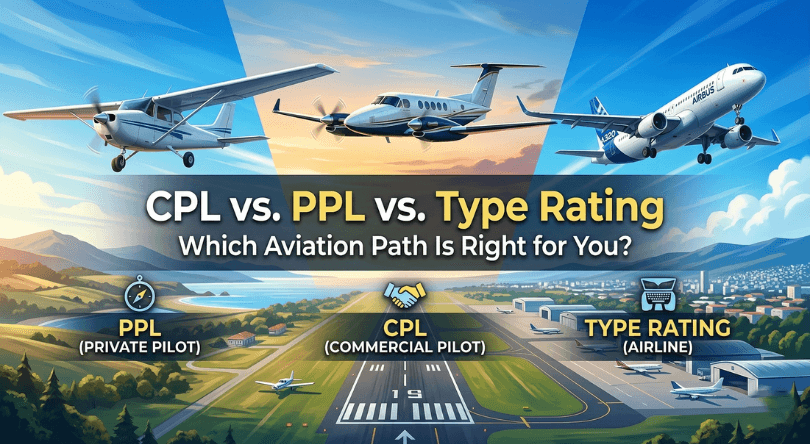
Choosing an aviation career is an exciting decision, but one that requires clarity, planning, and the right qualifications. If you’re exploring pilot training in India, you’ve likely come across three major terms—CPL, PPL, and Type Rating. Each represents a distinct aviation path, and choosing the right one depends on your career goals, budget, and long-term vision.
This detailed guide breaks down the differences between a Commercial Pilot License, Private Pilot License, and Type Rating course, helping you decide which aviation path is best for you.
Understanding the Aviation Licensing System
Before diving into comparisons, it’s important to understand how pilot licensing works. In India, pilot training is regulated by the Directorate General of Civil Aviation (DGCA). Globally, aviation authorities like the European Union Aviation Safety Agency (EASA) and the Federal Aviation Administration (FAA) govern licensing standards.
Each license serves a different purpose:
- PPL is for hobby or recreational flying
- CPL is for professional pilots
- Type Rating is aircraft-specific airline training
Let’s explore each in detail.
What Is a Private Pilot License (PPL)?
A Private Pilot License (PPL) allows you to fly an aircraft for personal or recreational purposes. However, you cannot earn money or work as a professional pilot with this license.
Key Features of PPL
- Ideal for aviation enthusiasts
- Lower training cost compared to CPL
- Limited flying privileges
- No airline or commercial job eligibility
Who Should Choose PPL?
- Flying as a hobby or passion
- Aircraft owners
- Business owners who want personal flying skills
- Students testing their interest before pursuing CPL
PPL Training Requirements
- Minimum 40–50 flight hours
- Basic ground school
- Medical fitness clearance
- Training at a DGCA-approved flying school
What Is a Commercial Pilot License (CPL)?
A Commercial Pilot License (CPL) is the most sought-after qualification for those who want to become airline pilots. It allows you to work professionally and earn income as a pilot.
Key Features of CPL
- Mandatory for airline jobs
- Allows paid flying
- Requires extensive training and exams
- Opens doors to domestic and international airlines
CPL Training Requirements
- Minimum 200 flight hours
- DGCA theory exams (Air Navigation, Meteorology, Regulations, etc.)
- Class 1 medical certification
- Instrument Rating (IR)
- Multi-Engine endorsement
Career Opportunities After CPL
- Airline First Officer
- Charter pilot
- Cargo pilot
- Corporate aviation pilot
A CPL is the foundation of a professional aviation career and is a prerequisite for airline selection programs.
What Is a Type Rating Course?
A Type Rating is specialized training that qualifies a pilot to operate a specific aircraft type, such as an Airbus A320 or Boeing 737. Even after earning a CPL, you cannot fly commercial jets without a type rating.
Common Aircraft Type Ratings
- Airbus A320
- Boeing 737
- ATR 72
- Airbus A320 Neo
Why Is Type Rating Important?
Airlines operate specific aircraft models, and pilots must be trained on that exact aircraft. Type rating includes:
- Full-flight simulator training
- Aircraft systems training
- SOP (Standard Operating Procedures)
- Airline-style checks
Many airlines either:
- Sponsor the type rating, or
- Require pilots to complete it independently
CPL vs. PPL vs. Type Rating: A Quick Comparison
CPL, PPL, and Type Rating each serve a different stage in a pilot’s journey, and confusing them can lead to costly decisions. A Private Pilot License (PPL) is the starting point, allowing you to fly for personal use without earning money. A Commercial Pilot License (CPL) takes it further by enabling you to fly professionally and get paid, making it essential for anyone aiming for an aviation career. Type Rating, on the other hand, is not a license but specialized training required to operate a specific aircraft like an Airbus A320 or Boeing 737 after obtaining a CPL. In simple terms, PPL is for hobby flying, CPL is for building a career, and a Type Rating is the final step that prepares you for airline jobs.
Which Aviation Path Is Right for You?
Choose PPL if:
- Flying is a personal passion
- You don’t want an airline career
- You want basic aviation skills
Choose CPL if:
- You aim to become an airline pilot
- You want a long-term aviation career
- You’re ready for intensive training
Choose Type Rating if:
- You already hold a CPL
- You’re preparing for airline induction
- You want to fly a specific aircraft
Most professional pilots follow this sequence: PPL (optional) → CPL → Type Rating → Airline Job
Importance of Choosing the Right Training Institute
Your success depends heavily on where you train. Always choose:
- A DGCA-approved flight training organization
- Institutes with advanced flight simulators
- Experienced instructors
- Airline-aligned training standards
Leading aviation training centers like Flight Simulation Technique Centre (FSTC) provide structured pathways from CPL training to advanced Type Rating courses, ensuring industry-ready pilots.
Final Thoughts
Understanding the difference between CPL vs. PPL vs. Type Rating is crucial before investing time and money into aviation training. Each path serves a unique purpose, and the right choice depends on whether you want to fly for passion or profession.
If your dream is to sit in an airline cockpit, CPL followed by a Type Rating is the clear path forward. With proper planning, the right training institute, and dedication, a rewarding aviation career is well within reach.