
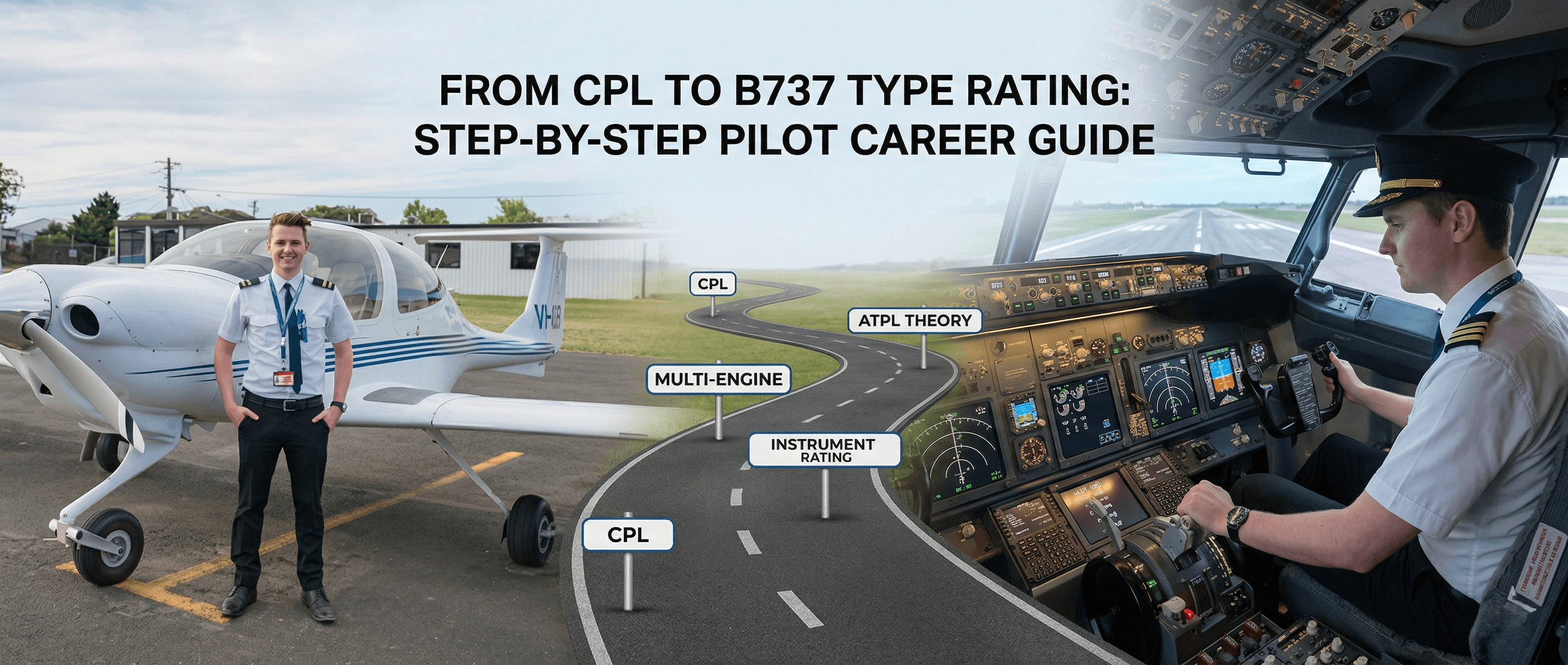
Earning your Commercial Pilot License is a deal but for people who want to be airline pilots it is just the beginning. To fly an airliner like the Boeing 737 you need a special certification called a B737 type rating. This certification teaches you how to operate the Boeing 737 and makes you an airline-ready pilot.
If you have your Commercial Pilot License and you are wondering how to get started with flying the Boeing 737 this guide will help you. We will walk you through the process from the prerequisites to your first flight.
What Is a Type Rating and Why the Boeing 737?
Under ICAO and EASA/FAA regulations, a type rating is an additional certification required to operate specific aircraft that meet criteria for complexity, performance, or weight—typically those exceeding 5,700 kg (12,500 lbs) MTOW or featuring turbojet engines.
The B737 type rating remains the most sought-after certification in commercial aviation for good reason. With over 10,000 aircraft operating globally across more than 500 airlines, the Boeing 737 (both NG and MAX variants) offers unmatched employment opportunities. Whether you aim to join a legacy carrier, low-cost airline, or cargo operator, this type rating serves as a universal passport to the flight deck.
Prerequisites: Before You Book the Course
You cannot simply walk into a training center with a CPL alone. Airlines and Approved Training Organizations (ATOs) require you to meet specific criteria before commencing B737 type rating training:
License Requirements: Hold a valid CPL (or ATPL) with a Multi-Engine Instrument Rating (ME/IR). Most airlines also require completion of ATPL theoretical knowledge exams, even if you haven’t yet accumulated the 1,500 hours needed for the full ATPL license.
Medical Certification: Possess a current Class 1 Medical Certificate without limitations that would restrict commercial operations.
English Proficiency: Demonstrate ICAO Level 4 English proficiency or higher (Level 6 preferred), as airline operations demand complex radiotelephony communication.
Flight Experience: While some integrated programs accept low-hours pilots immediately post-CPL, most airlines require 200–500 total flight hours before sponsoring a type rating. Self-sponsored candidates should aim for similar experience levels to remain competitive in the job market.
The Training Journey: Phase by Phase
B737 type rating training typically follows a structured protocol lasting 4–6 weeks, depending on whether you’re attending a full-time academy or airline-sponsored course.
Phase 1: Computer-Based Training (CBT) and Ground School
Before touching the simulator, expect 80–120 hours of classroom and computer-based instruction. You’ll master:
- Aircraft systems (hydraulics, electrical, avionics)
- Performance calculations and limitations
- Normal, abnormal, and emergency procedures
- Flight management system (FMS) architecture
Modern programs utilize Level D Full Flight Simulators (FFS), but theoretical foundations must be rock-solid first. Study groups and flashcard systems prove invaluable during this intensive academic period.
Phase 2: Fixed-Based Simulator (FBS) Training
Many ATOs utilize fixed-base trainers—simulators without motion platforms—to rehearse cockpit flows, checklist execution, and cockpit resource management. This cost-effective environment allows you to memorize the 737’s flight deck layout, practice FMC programming, and develop muscle memory for switchology without the hourly expense of full-motion simulation.
Phase 3: Full Flight Simulator (FFS) Training
This is where the B737 type rating truly comes alive. Over 32–40 hours in a Level D simulator, you’ll experience:
- Normal operations (takeoffs, climbs, cruise, approaches, landings)
- System failures and emergency scenarios (engine failures, hydraulic malfunctions, electrical emergencies)
- Low-visibility operations and CAT II/III approaches
- CRM (Crew Resource Management) integration with a training captain
The simulator phase culminates in the Skill Test (or LPC—License Proficiency Check), conducted by an authorized Type Rating Examiner (TRE). You must demonstrate competency in both aircraft handling and decision-making under pressure.
Phase 4: Base Training (Actual Aircraft)
Depending on your jurisdiction and airline requirements, you may complete 6–12 takeoffs and landings in the actual aircraft—a phase known as "base training" or "ZFTT" (Zero Flight Time Training) if transitioning from other types. This brief but vital session transitions simulator skills to the physical aircraft before you carry paying passengers.
Investment and Timeline Realities
A B737 type rating represents a significant financial investment. Self-sponsored courses typically range from €15,000 to €25,000 ($16,500–$27,500), depending on location and whether you’re certifying on the NG, MAX, or both variants.
Airline-sponsored programs (often called " MPL" or "cadet schemes") usually cover these costs, though they may require training bonds requiring you to remain with the carrier for 3–5 years to avoid repayment penalties.
Timeline-wise, expect:
- Weeks 1–2: Ground school and systems training
- Weeks 3–5: Simulator instruction and skill test
- Week 6: Base training (if required) and line orientation
Life After Certification: Building Your Career
Once you hold the B737 type rating, you’re technically qualified—but not yet experienced. Most pilots enter "line training" with a Training Captain, completing 40–100 sectors (flight segments) under supervision before earning their "Release to Line" (RTL) status.
The 737 family’s versatility means career progression typically follows this path:
- First Officer (Junior): Flying shorter sectors, building sector experience
- First Officer (Senior): Transitioning to longer routes, potentially upgrading to 737-800/900 or MAX variants
- Command Upgrade: After accumulating 3,000–4,000 hours on type, eligible for Captaincy transition courses
Preparation Strategies for Success
To maximize your B737 type rating experience:
Pre-Study Aircraft Systems: Download the FCOM (Flight Crew Operations Manual) and begin memorizing memory items and limitations before Day 1. Knowledge of the hydraulic system architecture and electrical schematics saves precious simulator hours.
Practice CRM Communication: The 737 is a two-pilot aircraft—success depends on communication, not solo heroics. Practice clear, concise callouts and challenge-and-response protocols with your simulator partner.
Mental Health Management: Simulator sessions are mentally exhausting. Maintain sleep hygiene, limit caffeine during evening sessions, and review videos of your sessions (most ATOs provide recordings) to reinforce learning.
Conclusion
Transitioning from CPL holder to Boeing 737 operator requires dedication, significant financial investment, and technical mastery. However, the B737 type rating remains one of aviation’s most valuable credentials—a certification that opens doors to global employment opportunities and the realization of childhood dreams.
Start by ensuring your prerequisites are solid, research your ATO carefully (seeking those with strong airline partnerships), and commit to the rigorous study habits that got you through your CPL. The flight deck of the world’s most successful commercial aircraft awaits—your journey from general aviation to airline professional is closer than you think.